What Is Artificial Intelligence? A Beginner’s Guide
Artificial intelligence is one of the most important technologies shaping the future of work, business, finance, banking, and data analytics.
In simple terms, artificial intelligence is the ability of software or machines to perform tasks that usually require human intelligence. These tasks may include understanding language, recognizing patterns, detecting fraud, making predictions, solving problems, and learning from data.
For a broader technical overview, IBM provides a useful introduction to artificial intelligence and its role in modern business.
You may already use artificial intelligence every day without noticing it. Search engines, banking apps, recommendation systems, chatbots, fraud detection tools, voice assistants, and translation apps all use some form of AI.
But what exactly is artificial intelligence, and why does it matter?
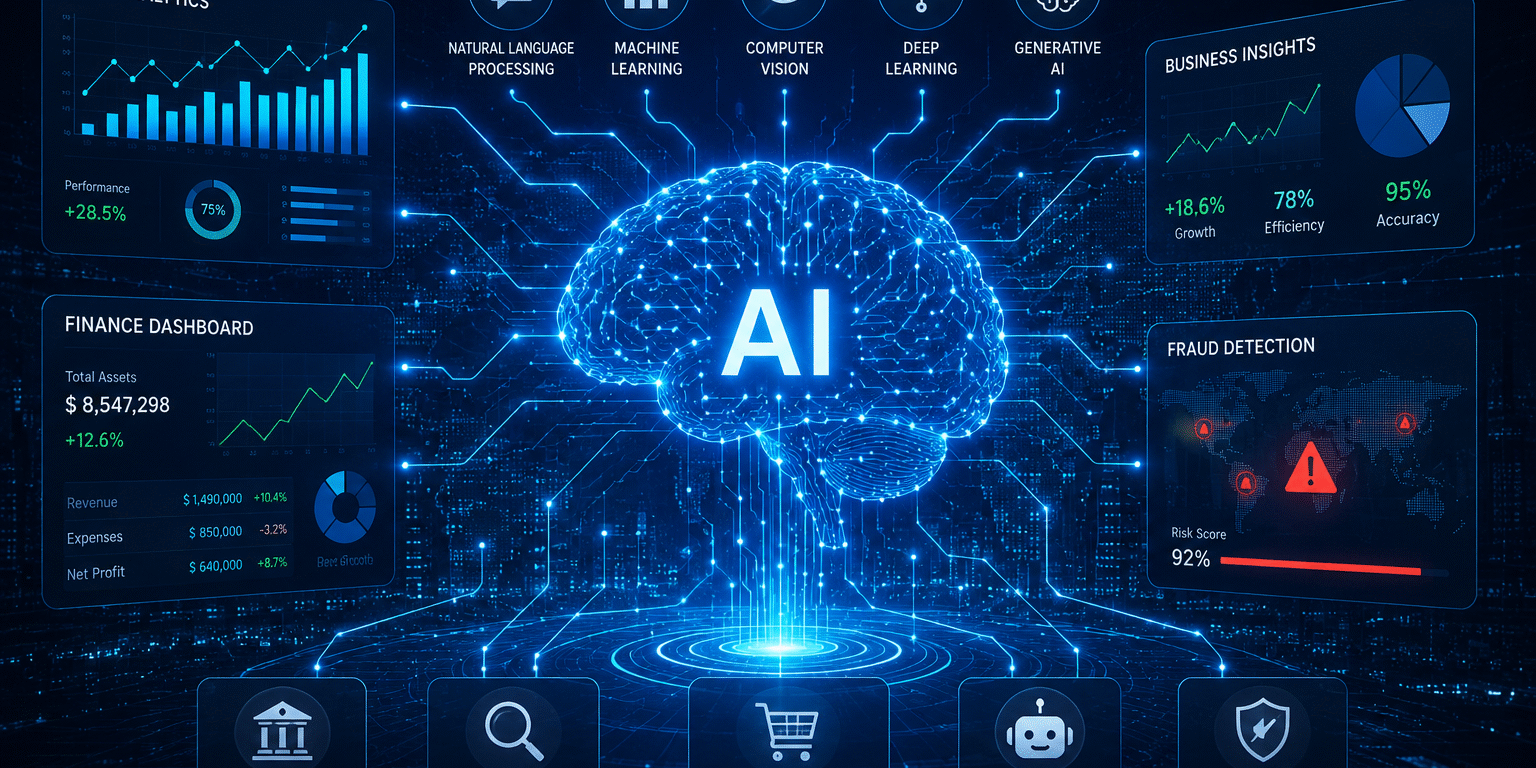
AI is not just one tool. It is a broad field that includes machine learning, deep learning, natural language processing, computer vision, robotics, and generative AI.
In this beginner’s guide, you will learn what artificial intelligence means, how it works, why it matters, and how it is used in real-world industries such as finance, banking, business, and data analytics.
What Is Artificial Intelligence?
Artificial intelligence is a field of computer science focused on building systems that can perform intelligent tasks.
These tasks can include:
- Understanding text
- Recognizing images
- Detecting fraud
- Predicting customer behavior
- Recommending products
- Translating languages
- Answering questions
- Automating decisions
- Learning from historical data
A simple definition is:
Artificial intelligence is the use of computers and algorithms to perform tasks that usually require human intelligence.
For example, when a bank detects a suspicious transaction, it may use AI to compare that transaction with thousands or millions of previous transactions. If the system finds unusual behavior, it can flag the transaction for review.
That is AI in action.
Why Artificial Intelligence Matters
AI matters because it helps people and organizations make better decisions, automate repetitive tasks, and discover patterns that would be difficult to find manually.
Businesses use AI to:
- Improve customer service
- Reduce operational costs
- Detect risks earlier
- Analyze large amounts of data
- Personalize products and services
- Forecast demand
- Improve productivity
For individuals, AI can help with:
- Writing
- Research
- Learning
- Coding
- Data analysis
- Career development
- Financial planning
- Productivity
AI is becoming a core skill, just like Excel, the internet, and basic digital literacy became essential in previous decades.
How Does Artificial Intelligence Work?
Most AI systems work by using data, algorithms, and computing power.
The general process looks like this:
- Data is collected.
- The data is cleaned and organized.
- An algorithm is trained on the data.
- The system learns patterns.
- The system uses those patterns to make predictions or decisions.
For example, imagine an AI system designed to predict whether a customer may default on a loan.
The system may analyze data such as:
- Income
- Credit history
- Debt level
- Payment behavior
- Employment status
- Account activity
Based on historical examples, the AI model learns which patterns are associated with higher or lower credit risk.
The goal is not magic. The goal is pattern recognition at scale.
Main Types of Artificial Intelligence
There are several important areas within AI.
1. Machine Learning
Machine learning is a branch of AI where systems learn from data instead of being directly programmed for every situation.
For example, instead of writing thousands of rules to detect spam emails, a machine learning model can learn from examples of spam and non-spam emails.
Machine learning is widely used in:
- Fraud detection
- Credit scoring
- Customer segmentation
- Sales forecasting
- Recommendation systems
- Risk analysis
2. Deep Learning
Deep learning is a more advanced form of machine learning that uses artificial neural networks.
It is especially powerful for complex tasks such as:
- Image recognition
- Speech recognition
- Natural language processing
- Autonomous driving
- Medical imaging
- Large language models
Many modern AI tools, including advanced chatbots and image generators, use deep learning.
3. Natural Language Processing
Natural language processing, or NLP, allows computers to understand and generate human language.
NLP is used in:
- Chatbots
- Translation tools
- Search engines
- Text summarization
- Sentiment analysis
- Voice assistants
- Document analysis
Tools like ChatGPT, Claude, Gemini, and Copilot are examples of AI systems that use natural language processing.
4. Computer Vision
Computer vision allows machines to understand images and videos.
It is used in:
- Facial recognition
- Medical scans
- Quality control
- Security systems
- Autonomous vehicles
- Object detection
For example, an insurance company may use computer vision to analyze images of vehicle damage after an accident.
5. Generative AI
Generative AI is a type of AI that can create new content.
It can generate:
- Text
- Images
- Code
- Music
- Videos
- Presentations
- Reports
Examples include ChatGPT, Gemini, Claude, Midjourney, DALL·E, and GitHub Copilot.
Generative AI is one of the fastest-growing areas of artificial intelligence because it can support knowledge work, education, software development, marketing, data analysis, and business communication.
Real-World Examples of AI
AI is already used in many industries.
AI in Finance
In finance, AI is used for:
- Fraud detection
- Credit risk analysis
- Portfolio analysis
- Customer segmentation
- Market forecasting
- Automated reporting
- Financial document analysis
For example, an AI system can analyze thousands of transactions and detect unusual activity much faster than a human reviewer.
AI in Banking
Banks use AI to improve customer experience, security, and operational efficiency.
Common banking applications include:
- Chatbots
- Transaction monitoring
- Anti-money laundering support
- Credit scoring
- Personalized product recommendations
- Risk management
- Customer service automation
AI does not replace human judgment completely, but it helps banking professionals make faster and more informed decisions.
AI in Data Analytics
AI helps data analysts work faster and smarter.
It can assist with:
- Cleaning data
- Finding patterns
- Creating charts
- Writing SQL queries
- Generating Python code
- Explaining dashboards
- Predicting future trends
- Summarizing large datasets
For data professionals, AI is becoming a productivity multiplier.
AI in Business
Businesses use AI to:
- Forecast sales
- Optimize inventory
- Improve marketing campaigns
- Automate customer support
- Analyze customer feedback
- Reduce costs
- Improve decision-making
A retail company, for example, can use AI to predict which products will sell more during a specific season.
Is AI the Same as Automation?
AI and automation are related, but they are not the same.
Automation follows predefined rules.
AI can learn from data and adapt to patterns.
For example:
A simple automation rule might say:
If a customer spends more than $10,000, send an alert.
An AI system might analyze many factors and detect suspicious behavior even if the transaction is below $10,000.
Automation follows instructions. AI finds patterns.
Benefits of Artificial Intelligence
AI can provide many benefits, including:
- Faster decision-making
- Better predictions
- Reduced manual work
- Improved customer experience
- Lower operational costs
- More accurate analysis
- Better risk detection
- Personalized services
For professionals, AI can help improve productivity and make complex tasks easier to manage.
Limitations of Artificial Intelligence
AI is powerful, but it is not perfect.
Some limitations include:
- AI can make mistakes.
- AI depends on data quality.
- AI may reflect bias in training data.
- AI may generate incorrect information.
- AI may lack human judgment.
- AI systems need monitoring and governance.
This is why AI should be used carefully, especially in high-stakes areas such as finance, banking, healthcare, law, and education.
Will AI Replace Jobs?
AI will change many jobs, but it will not replace every worker.
A better way to think about it is:
AI will not replace all professionals, but professionals who use AI effectively may outperform those who do not.
Many jobs will change because repetitive tasks can be automated. However, human skills will remain important, especially skills such as:
- Critical thinking
- Communication
- Judgment
- Problem-solving
- Ethics
- Domain knowledge
- Leadership
In fields such as finance, banking, and data analytics, the best professionals will likely be those who combine technical skills, business knowledge, and AI literacy.
Skills You Need to Learn AI
If you are a beginner, you do not need to learn everything at once.
A practical AI learning roadmap may include:
- Learn basic AI concepts.
- Learn data analytics fundamentals.
- Learn Excel or Google Sheets.
- Learn SQL.
- Learn Python.
- Learn basic statistics.
- Learn machine learning fundamentals.
- Learn prompt engineering.
- Build small AI projects.
- Apply AI to a real business problem.
The best way to learn AI is not only to read about it, but to build practical projects.
Common AI Tools Beginners Should Know
Here are some useful AI tools for beginners:
- ChatGPT
- Gemini
- Claude
- Microsoft Copilot
- Perplexity
- GitHub Copilot
- Google Colab
- Jupyter Notebook
- Power BI
- Excel with Copilot
You do not need to master all of them immediately. Start with one or two tools and use them consistently.
How to Start Learning AI
If you are new to AI, start with practical questions:
- What is AI?
- What is machine learning?
- What is generative AI?
- How does ChatGPT work?
- How can AI help me in my career?
- How can AI be used in finance?
- How can AI be used in data analytics?
Then move to projects.
Good beginner projects include:
- AI resume analyzer
- Sales forecasting dashboard
- Customer churn prediction
- Credit risk analysis
- Chatbot for customer support
- Financial statement summarizer
- AI-powered Excel assistant
Projects help you move from theory to real-world application.
Final Thoughts
Artificial intelligence is not just a future technology. It is already part of modern business, finance, banking, education, and data analytics.
For beginners, the most important step is to understand the core concepts and then apply them to real problems.
You do not need to become an AI researcher to benefit from AI. You can start by learning how AI works, how to use AI tools, and how to apply AI to your field.
In the coming years, AI literacy will become one of the most valuable professional skills.
If you want to build a strong career in data, finance, banking, or technology, learning artificial intelligence is a smart place to start.
FAQ
What is artificial intelligence in simple words?
Artificial intelligence is the ability of computers or software systems to perform tasks that usually require human intelligence, such as learning, reasoning, problem-solving, and understanding language.
Is AI the same as machine learning?
No. Machine learning is a branch of artificial intelligence. AI is the broader field, while machine learning focuses on systems that learn from data.
What are examples of AI?
Examples of AI include chatbots, fraud detection systems, recommendation engines, voice assistants, image recognition tools, and generative AI platforms like ChatGPT.
Is ChatGPT artificial intelligence?
Yes. ChatGPT is an example of generative AI and uses natural language processing to understand and generate text.
Why is AI important in finance?
AI is important in finance because it helps detect fraud, analyze risk, automate reports, improve customer service, and process large amounts of financial data.
Can beginners learn AI?
Yes. Beginners can start by learning basic AI concepts, data analytics, SQL, Python, statistics, and practical AI tools.
Author: Sepehr Mehrvar