What Is Generative AI?
Introduction
What is Generative AI? If you’ve spent any time online recently, you’ve likely heard the term thrown around. AI model has moved past the tech-buzzword phase and is now fundamentally changing how we work, create, and solve problems. It’s the engine powering tools like ChatGPT, Google Gemini, Anthropic’s Claude, and Microsoft Copilot.
But what exactly is it?
Unlike the older algorithms you might be used to—which exist purely to crunch numbers, analyze existing data, or predict trends—generative AI does exactly what its name implies: it creates. Whether you need a draft of an email, a line of Python code, or an entirely new image, this technology generates fresh content from scratch based on a simple text prompt.
In this guide, we’ll break down what generative AI is, peek under the hood to see how it works, and explore why industries from software development to high-stakes finance are rushing to adopt it.
Learn more about generative AI from the IBM guide to Generative AI.
Table of Contents
-
What Is Generative AI?
-
How Does Generative AI Work?
-
Traditional AI vs. Generative AI
-
Popular Generative AI Tools
-
Real-World Applications
-
The Real Benefits of Generative AI
-
Challenges and Limitations You Should Know
-
Deep Dive: Generative AI in Banking and Finance
-
Frequently Asked Questions
-
Key Takeaways
What Is Generative AI?
At its core, generative AI is a branch of artificial intelligence designed to produce new, original content rather than simply analyzing what already exists.
Depending on the specific model you’re using, it can instantly generate a wide variety of formats, including:
-
Text (essays, reports, emails)
-
Images and artwork
-
Computer code
-
Audio and synthetic voices
-
Music tracks
-
Video clips
-
Presentations
Instead of relying on a rigid set of pre-programmed rules (like a standard computer program), generative AI learns from massive, sprawling datasets. It studies the patterns in human-created content and uses that knowledge to output results that feel surprisingly natural and human-like.
How Does Generative AI Work?
It might look like magic, but it’s actually incredibly advanced statistics. Modern generative AI systems are trained on billions of examples—everything from classic literature and public websites to software repositories and research papers.
During this intense training phase, the model acts like a sponge, absorbing:
-
Language patterns and complex grammar
-
The contextual relationships between words
-
Logical reasoning steps
-
Visual features (for image models)
-
Coding syntax and structures
When you type a prompt into a tool like ChatGPT, the AI isn’t “thinking” about your question the way a human would. Instead, it relies on everything it learned during training to predict the most logical sequence of words (or pixels) to follow your prompt. It’s essentially the world’s most powerful autocomplete.
Traditional AI vs Generative AI
| Feature |
Traditional AI (The Analyzers) |
Generative AI (The Creators) |
|
Core Function |
Predicts outcomes or categorizes data. |
Creates entirely new, original content. |
|
Fraud Example |
Detects anomalous transactions. |
Writes the fraud investigation summary report. |
|
Email Example |
Flags an incoming message as spam. |
Drafts a polite reply to a client’s email. |
|
Business Example |
Forecasts next quarter’s sales volume. |
Generates a narrative business report based on those sales. |
|
Visual Example |
Recognizes a cat in a photo. |
Paints a new, unique picture of a cat in space. |
Popular Generative AI Tools
The landscape is evolving fast, but here are the heavy hitters currently leading the market:
|
Tool |
Primary Strength / Best Use Case |
|
ChatGPT |
Text generation, complex coding, and logical reasoning. |
|
Google Gemini |
Multimodal tasks (seamlessly combining text, image, and data). |
|
Claude |
Digesting and analyzing incredibly long documents. |
|
Microsoft Copilot |
Workplace productivity (integrated directly into Office apps). |
|
Midjourney |
High-fidelity, artistic image generation. |
|
DALL·E |
Quick, prompt-accurate image generation. |
Learn more about Gemini on Google’s official website.
Real World Applications
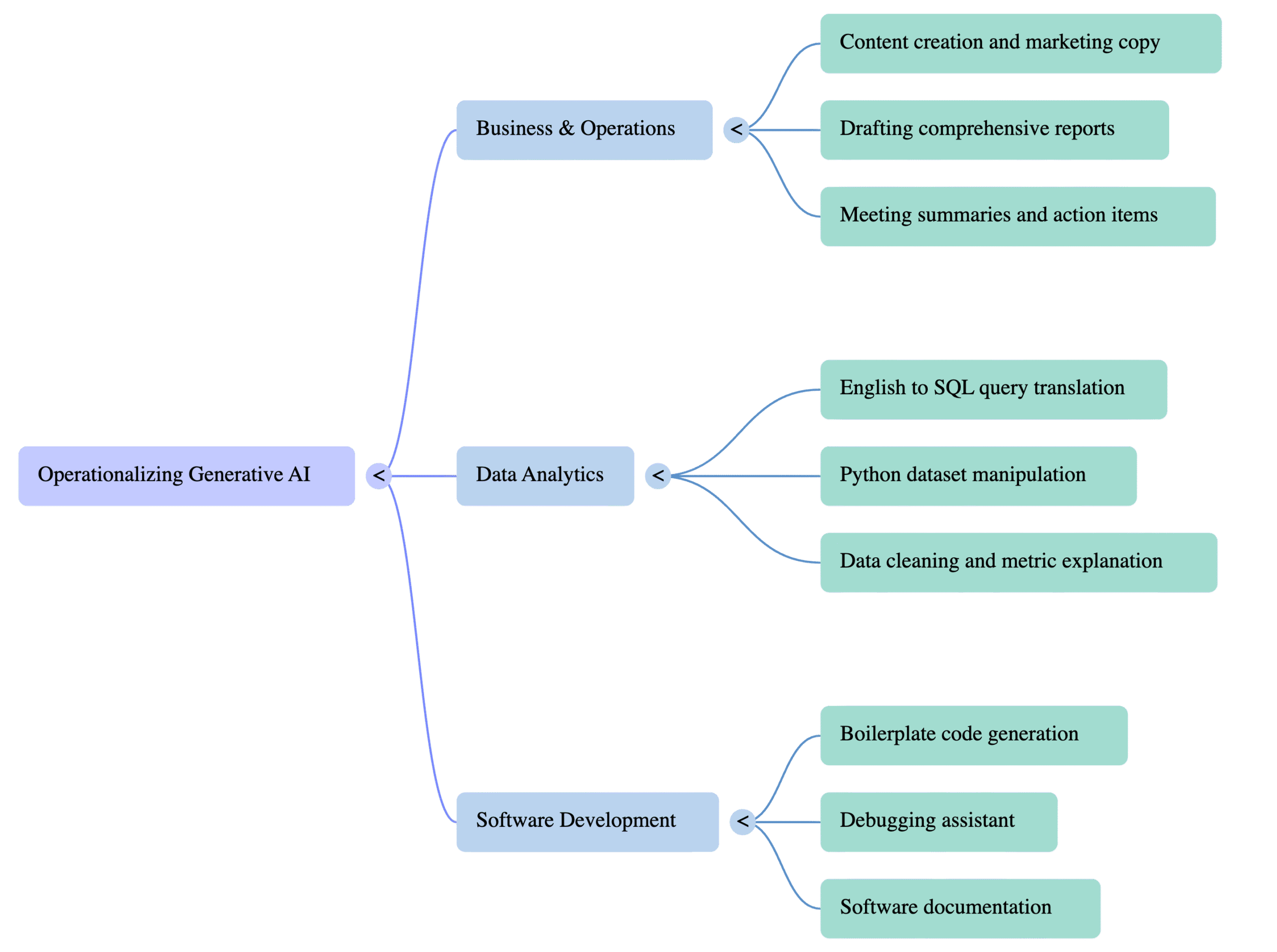
Generative AI isn’t just a fun toy; it’s a massive productivity booster across almost every sector.
The Real Benefits of Generative AI
Why are companies investing so heavily in this? The ROI usually comes down to a few key areas:
-
Unmatched Speed: Creating first drafts of content or code in seconds rather than hours.
-
Productivity Spikes: Automating the repetitive, boring tasks so humans can focus on strategy.
-
Always-On Support: Powering smarter, more conversational customer service bots.
-
Overcoming Blank Page Syndrome: Giving writers and creators an immediate jumping-off point.
Challenges and Limitations You Should Know
For all its power, generative AI has some very real flaws. Treating it as an infallible source of truth is a mistake. Keep these limitations in mind:
-
Hallucinations: AI models will sometimes confidently invent facts that are completely untrue.
-
Outdated Information: Unless connected to the live web, models only “know” what was in their training data.
-
Built-in Bias: If the training data had human biases, the AI’s output likely will too.
-
Privacy & Copyright: Feeding confidential company data into public AI tools can lead to massive security breaches, and the legal landscape around AI-generated copyright is still murky.
The Golden Rule: AI is a brilliant assistant, but it should never replace human critical thinking and verification.
Deep Dive: Generative AI in Banking and Finance
Because of the heavy regulations in the financial sector, banks were initially cautious. Now, they are finding secure ways to deploy generative AI to streamline massive operations.
Financial institutions use these models for:
-
Building internal knowledge bases where staff can quickly query complex company policies.
-
Summarizing dense, hundred-page financial documents or earnings call transcripts.
-
Assisting in compliance monitoring and risk documentation.
-
Drafting routine financial reports.
However, because the stakes in banking are so high, a “human-in-the-loop” approach is mandatory. Every piece of AI-generated analysis must be reviewed by a qualified professional before it influences a customer-facing decision.
Frequently Asked Questions
Is ChatGPT the exact same thing as Generative AI? No. Think of Generative AI as the broad category (like “vehicles”) and ChatGPT as one specific model within that category (like a “Honda Civic”). ChatGPT is an application built on top of a Large Language Model (LLM).
Will Generative AI replace human workers? It’s highly unlikely to replace most jobs entirely. Instead, it will augment human work. The most realistic scenario is that professionals who know how to use AI will replace those who don’t. It handles the repetitive heavy lifting so you can focus on high-level decision-making.
Is Generative AI safe to use? It is safe if used responsibly. The biggest risk is data privacy. You should never paste confidential client data, sensitive financial information, or proprietary code into a public AI tool unless your company has secured a private, enterprise-level agreement with the provider.
Author: Sepehr Mehrvar