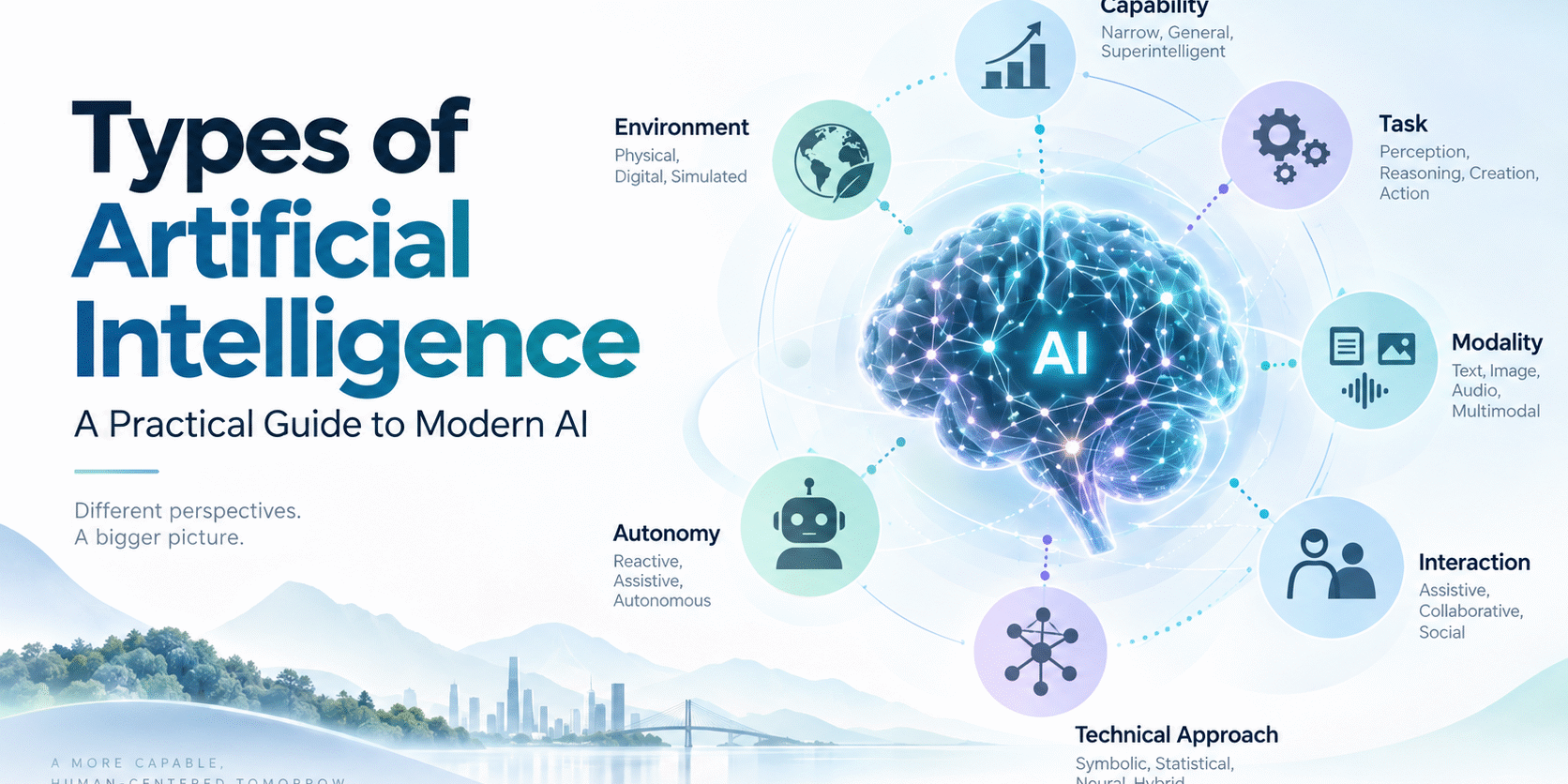
Types of Artificial Intelligence: A Practical Guide to Modern AI
Artificial intelligence is often explained through simple lists.
Some articles describe three types of AI: Narrow AI, Artificial General Intelligence, and Artificial Superintelligence. Others describe four: Reactive Machines, Limited-Memory AI, Theory-of-Mind AI, and Self-Aware AI. More recent discussions introduce terms such as Generative AI, Multimodal AI, Reasoning Models, and AI Agents.
So which classification is correct?
The answer is that these labels describe different dimensions of artificial intelligence.
Generative AI describes what a system produces. Multimodal AI describes the types of information it can process. Agentic AI describes how a system pursues goals and takes actions. Narrow AI and AGI attempt to describe the breadth of a system’s capabilities.
A single AI system can therefore belong to several categories at the same time.
For example, an AI business assistant might be:
- Narrow in overall capability
- Generative because it creates reports
- Multimodal because it analyzes text, tables, and images
- Conversational because users interact with it through natural language
- Agentic if it can retrieve data, use tools, and perform multiple actions
Rather than memorizing one fixed list of AI types, it is more useful to understand which dimension each label describes.
Note: The framework in this article is a practical analytical model rather than an official industry taxonomy. Its purpose is to separate concepts that are frequently mixed together when explaining modern AI.
The Main Ways to Classify Artificial Intelligence
A practical way to analyze an AI system is to ask several different questions.
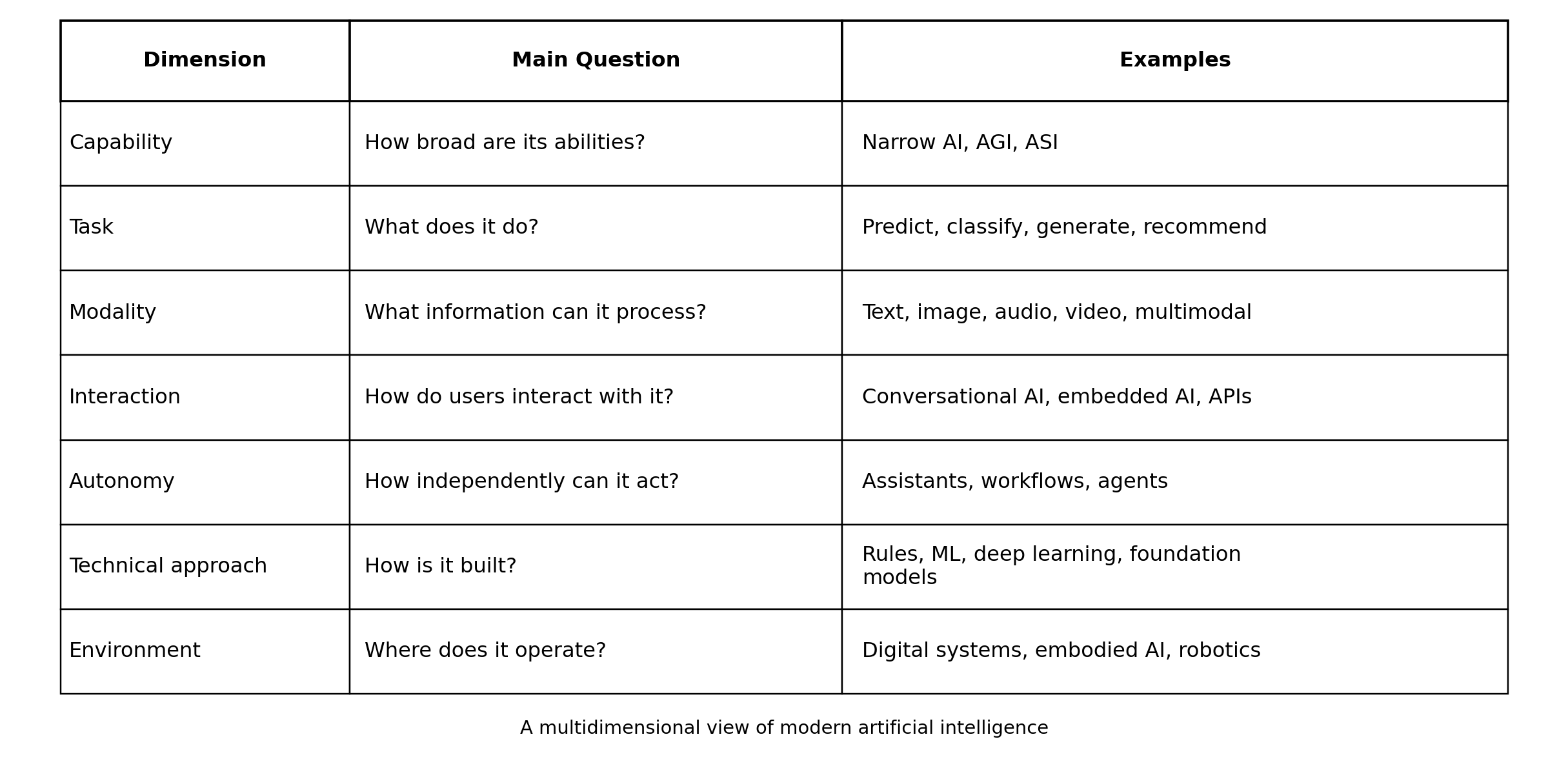
These dimensions overlap.
An AI system does not need to belong to only one category.
That is one of the most important ideas to understand about modern artificial intelligence.
What Is Artificial Intelligence?
Artificial intelligence is a broad field concerned with building systems capable of performing tasks involving abilities such as perception, learning, reasoning, planning, communication, prediction, and decision-making.
There is no single definition used in every technical or regulatory context. NIST, for example, maintains several AI definitions drawn from different publications and explicitly notes that terminology should be interpreted in the context of its source.
AI therefore refers to a broad family of technologies rather than one specific technique.
These technologies include:
- Machine learning
- Deep learning
- Natural language processing
- Computer vision
- Generative models
- Recommendation systems
- Robotics
- Optimization systems
- AI agents
Before examining the types of AI, however, it is important to distinguish three concepts that are frequently confused.
AI Model vs. AI System vs. AI Application
A model, an AI system, and an AI application are not the same thing.
AI Model
An AI model is the computational component that has learned patterns from data or has otherwise been designed to produce outputs from inputs.
Examples include:
- A fraud-classification model
- A large language model
- An image-generation model
- A computer-vision model
The model itself is only one component of many modern AI products.
AI System
An AI system may combine the model with additional components such as:
- External tools
- Databases
- Retrieval systems
- APIs
- Memory
- Business rules
- Security controls
- Guardrails
- Workflow logic
NIST uses a broad definition of AI systems that can include software, hardware, applications, tools, or utilities operating partly or entirely through AI.
This distinction becomes especially important when discussing AI agents.
A language model alone is not automatically an agent.
AI Application
An AI application is the product or interface through which a user interacts with an AI system.
A customer-service application, for example, might combine:
Language model + company documents + retrieval + CRM tools + authentication + user interface
The capabilities of the entire product should therefore not automatically be attributed to the underlying model.
AI vs. Machine Learning vs. Deep Learning
Artificial intelligence is the broadest concept.
Machine learning (ML) is an approach in which systems learn patterns from data instead of relying entirely on manually programmed rules.
Deep learning (DL) is a branch of machine learning that uses multilayer neural networks.
The relationship is often summarized as:
Artificial Intelligence → Machine Learning → Deep Learning
However, this hierarchy should not be mixed with labels such as Generative AI or Multimodal AI.
For example:
Deep learning describes a technical approach.
Generative AI describes the type of output a system is designed to produce.
Multimodal AI describes the kinds of information it can process.
Agentic AI describes goal-directed behavior involving actions and tools.
These categories answer different questions.
1. Types of Artificial Intelligence Based on Capability
One widely used conceptual framework divides AI into three categories:
- Artificial Narrow Intelligence
- Artificial General Intelligence
- Artificial Superintelligence
This framework describes the breadth of a system’s capabilities.
Artificial Narrow Intelligence
Artificial Narrow Intelligence (ANI) refers to systems designed to perform specific tasks or bounded groups of tasks.
Examples include:
- Fraud detection
- Recommendation systems
- Image recognition
- Demand forecasting
- Machine translation
- Search
- Code generation
- Predictive maintenance
The word narrow does not mean that these systems must be simple.
Modern AI models can perform many sophisticated tasks.
A language model may summarize documents, generate code, translate text, answer questions, and analyze information.
That breadth of functionality does not automatically establish human-like general intelligence.
Under the conventional ANI–AGI–ASI framework, currently deployed AI systems are generally treated as Narrow AI.
Artificial General Intelligence
Artificial General Intelligence (AGI) describes the proposed idea of an AI capable of performing intellectual tasks across many domains with broad adaptability and generality.
An AGI might theoretically be able to:
- Learn unfamiliar tasks
- Transfer knowledge between domains
- Adapt to novel environments
- Solve unfamiliar problems
- Apply knowledge without extensive task-specific retraining
However, there is no universally accepted technical threshold for determining exactly when a system becomes AGI.
This matters because AI capability is not easily summarized with a single number.
Stanford’s 2026 AI Index reports rapid improvements across areas including reasoning and agentic tasks, while also highlighting benchmark saturation and reliability problems. Strong performance on individual benchmarks therefore does not automatically establish general intelligence.
AGI is best understood as a debated capability concept rather than an established category of deployed AI products.
Artificial Superintelligence
Artificial Superintelligence (ASI) refers to a hypothetical form of intelligence that would exceed human capability across a broad range of intellectual domains.
ASI remains speculative.
It is mainly relevant to discussions about the possible long-term development of artificial intelligence.
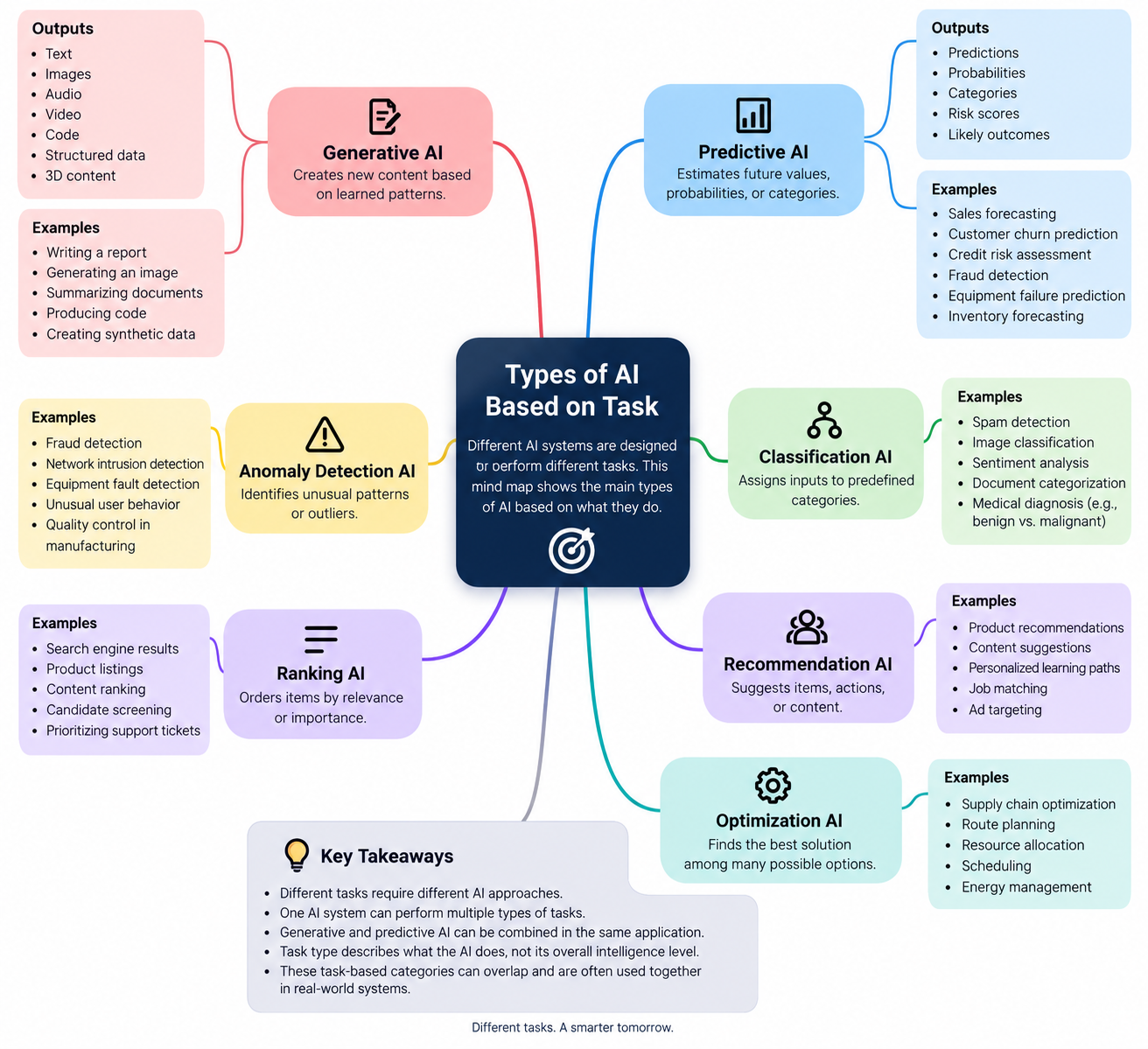
2. Types of Artificial Intelligence Based on Task
For practical applications, it is often more useful to classify AI by what it actually does.
AI systems may perform tasks such as:
- Classification
- Prediction
- Generation
- Recommendation
- Ranking
- Optimization
- Anomaly detection
Two labels are especially common today: Predictive AI and Generative AI.
Predictive AI
“Predictive AI” is commonly used in business and analytics for systems designed to estimate:
- Future values
- Probabilities
- Categories
- Risks
- Likely outcomes
Examples include:
- Sales forecasting
- Customer churn prediction
- Credit-risk assessment
- Fraud detection
- Equipment-failure prediction
- Inventory forecasting
A predictive model might answer:
How much will demand increase next month?
or:
How likely is this transaction to be fraudulent?
Predictive AI should be understood mainly as a useful application label rather than a fundamental category of intelligence.
Generative AI
Generative AI is designed to create new content based on patterns learned from data.
Its outputs can include:
- Text
- Images
- Audio
- Video
- Software code
- Structured data
- 3D content
Examples include:
- Writing a report
- Generating an image
- Summarizing documents
- Producing software code
- Creating synthetic data
Predictive AI vs. Generative AI
A common explanation says:
Predictive AI predicts. Generative AI creates.
This is useful, but technically incomplete.
Generative models also perform prediction internally. Large language models, for example, generate text through probabilistic prediction of subsequent tokens.
A more precise distinction is:
Predictive systems are typically optimized to estimate values, categories, probabilities, or future outcomes.
Generative systems are optimized to produce new structured or unstructured content.
A single application can combine both.
For example, an analytics system could predict next quarter’s sales and then generate a written explanation of the forecast.
3. Types of Artificial Intelligence Based on Modality
A modality is a type of information processed or generated by an AI system.
Examples include:
- Text
- Images
- Audio
- Video
- Tables
- Sensor data
Single-Modality AI
Some systems work mainly with one form of information.
Examples include:
- Text classification
- Image defect detection
- Speech recognition
- Tabular forecasting
Multimodal AI
Multimodal AI works with multiple types of information.
For example:
Text + image → text
Text → image
Video + audio + text → structured analysis
Multimodality can involve:
- Multiple input types
- Multiple output types
- Cross-modal reasoning
- Fusion of information across modalities
Consider an AI system reviewing an engineering report containing text, photographs, charts, and tables.
A multimodal system may be able to analyze relationships across those different sources.
However, multimodal does not automatically mean “more intelligent.”
It describes the information channels a system can process.
4. Reasoning AI
The term reasoning model has become increasingly common as AI systems improve at mathematics, coding, planning, scientific problems, and multi-step tasks.
Reasoning, however, is better treated as a capability characteristic rather than another independent AI type.
Reasoning capabilities can appear in:
- Language models
- Multimodal models
- Coding systems
- Planning systems
- AI agents
This distinction matters because AI capability is often uneven.
A system may perform exceptionally well on one difficult benchmark while failing on apparently simpler tasks.
The 2026 Stanford AI Index illustrates both rapid capability gains and continuing reliability limitations, including substantial failure rates for agents on structured computer-use benchmarks.
Strong reasoning ability in selected tasks should therefore not automatically be equated with AGI.
5. Types of Artificial Intelligence Based on Interaction
Another dimension concerns how people and software interact with AI.
Conversational AI
Conversational AI allows interaction using natural language.
Examples include:
- Chatbots
- Voice assistants
- Customer-support assistants
- AI analytics assistants
Conversational AI is an interaction pattern, not an intelligence level.
A conversational system may be:
- Rule-based
- Generative
- Multimodal
- Agentic
An older chatbot may rely on predefined decision trees, while a modern conversational system may rely on a foundation model and external tools.
Both can still be described as conversational AI.
Embedded AI
Many AI systems operate invisibly inside other applications.
Examples include:
- Fraud detection in banking software
- Recommendation algorithms in e-commerce
- Search ranking
- Predictive maintenance
- Automated quality inspection
The user interacts with the application rather than directly with the AI model.
API-Based AI
AI models can also be exposed through APIs.
Other applications can send information to the AI system, receive results, and integrate those outputs into broader workflows.
6. AI Assistants, Workflows, and Agents
One of the most important distinctions in modern AI is the difference between an assistant, workflow, and agent.
Not every application using a language model is an AI agent.
AI Assistant
An assistant mainly responds to user instructions.
For example:
User: Summarize this report.
Assistant: Returns a summary.
The interaction may be sophisticated, but the system primarily responds to explicit requests.
AI Workflow
An AI workflow connects multiple predefined operations.
For example:
- Generate an outline
- Write a draft
- Review the draft
- Revise it
- Produce the final article
Even if each step uses a language model, the process is still primarily a workflow when the sequence is predetermined by software.
Anthropic makes this distinction explicitly: workflows follow predefined code paths, whereas agents allow the model to dynamically direct its process and tool use.
This gives us an important rule:
Multiple LLM calls do not automatically create an AI agent.
AI Agent
An AI agent has greater control over how a goal is accomplished.
It may:
- Determine what information is required
- Choose tools
- Search for additional context
- Evaluate intermediate results
- Modify its plan
- Take actions
- Determine when the task is complete
OpenAI similarly describes agents as systems in which an LLM manages workflow execution, makes decisions, selects tools, and operates within defined guardrails.
Consider this request:
“Investigate why sales declined this month and prepare a report.”
An agent might:
- Retrieve sales data
- Identify the largest decline
- Decide to examine regions separately
- Query additional data
- Compare product categories
- Generate charts
- Draft an explanation
- Ask for approval before distributing the report
Unlike a fixed workflow, the exact sequence may depend on what the system discovers.
Autonomy Is Multidimensional
AI autonomy should not be treated as a simple switch between “autonomous” and “not autonomous.”
Several characteristics matter.
Initiative
Can the system decide what step to perform next?
Planning
Can it create or revise a multi-step strategy?
Tool Selection
Can it determine which tools to use?
Action Authority
Can it change external systems, or only provide recommendations?
Persistence
Can it continue working through multiple stages?
Human Oversight
Does it require human approval before important actions?
An agent may have sophisticated planning capabilities but extremely limited permission to act.
Another system may use simpler reasoning but have permission to automatically update business records.
Neither can be described accurately using a single “autonomy score.”
Agentic AI Does Not Mean Unlimited Autonomy
Real-world AI agents typically operate within defined constraints.
These may include:
- Tool permissions
- Security policies
- Business rules
- Human approvals
- Spending limits
- Maximum iteration counts
- Audit logs
- Guardrails
Agentic systems can also introduce additional operational complexity.
Anthropic notes that agents are most useful when flexibility and model-directed decision-making justify the additional latency, cost, and complexity compared with simpler workflows.
More autonomy is therefore not automatically better.
7. Types of Artificial Intelligence Based on Technical Approach
Technical classifications require additional care because several layers are frequently mixed together.
Rule-Based AI
Rule-based systems follow logic explicitly defined by humans.
For example:
IF transaction amount exceeds threshold AND location is unusual → flag transaction
These systems remain useful when rules are stable and explainability is important.
Machine Learning
Machine-learning systems learn patterns from data.
Important learning paradigms include:
- Supervised learning
- Unsupervised learning
- Self-supervised learning
- Reinforcement learning
These terms describe how learning occurs, not the final purpose of the application.
Deep Learning
Deep learning uses multilayer neural networks to learn complex representations.
It underpins many applications in:
- Computer vision
- Speech recognition
- Natural language processing
- Generative AI
Model Architectures
Architecture describes how a model is structured.
Examples include:
- Transformers
- Convolutional neural networks
- Diffusion models
- Recurrent neural networks
These should not be confused with intelligence categories.
A transformer, for example, is an architecture—not an AI capability level.
Foundation Models
Foundation models are broadly trained models designed to support many downstream tasks.
They may support:
- Generation
- Summarization
- Translation
- Classification
- Coding
- Question answering
Foundation models are typically built using deep learning.
That means Deep Learning → Foundation Models should not be interpreted as a simple progression of intelligence levels.
They describe different aspects of how AI systems are built.
Retrieval, Memory, and Tools Are System Components
Modern AI applications frequently combine a foundation model with additional components.
A simplified architecture might look like:
Model + Retrieval + Tools + Memory + Guardrails
Retrieval-Augmented Generation, or RAG, allows a system to retrieve relevant external information and provide it to a generative model as context.
However:
RAG is not a new intelligence level.
Memory is not automatically a new type of AI.
Tool use alone does not make a system an agent.
These are system-level design choices.
8. Digital AI vs. Embodied AI
Most commonly used AI systems operate in digital environments.
Examples include:
- Chatbots
- Recommendation engines
- Analytics systems
- Search
- Coding assistants
Other AI systems interact directly with the physical world.
Embodied AI
Embodied AI refers to systems that perceive and act within physical environments using sensors and actuators.
Examples include:
- Industrial robots
- Autonomous vehicles
- Warehouse robots
- Robotic manipulation systems
Embodied AI introduces additional challenges because physical environments can be unpredictable.
Stanford’s 2026 AI Index, for example, reports a large gap between robot performance in controlled benchmarks and performance on real household tasks.
This illustrates an important principle:
Strong digital benchmark performance does not automatically translate into robust physical-world intelligence.
The Classic Four Types of Artificial Intelligence—and Their Limitations
Many introductory articles divide AI into four functional categories:
- Reactive Machines
- Limited-Memory AI
- Theory-of-Mind AI
- Self-Aware AI
This framework can be useful conceptually, but it is less useful for describing modern production systems.
Reactive Machines
Reactive systems respond to current inputs without relying on persistent experience.
IBM’s Deep Blue chess system is commonly used as an example.
Limited-Memory AI
Limited-memory AI is generally described as AI that incorporates previous information when making decisions.
The difficulty is that the word memory now covers many different mechanisms.
It might refer to:
- Training data
- Conversation context
- Retrieved documents
- Application state
- Historical features
- Persistent user information
These mechanisms are technically different.
Calling all modern systems “limited-memory AI” can therefore hide important distinctions.
Theory-of-Mind AI
Theory-of-mind AI refers to hypothetical systems capable of understanding human beliefs, intentions, motivations, and mental states.
Current AI can detect patterns associated with emotion or intent, but that should not automatically be interpreted as human-like understanding.
Self-Aware AI
Self-aware AI refers to hypothetical machines possessing awareness of their own existence or internal states.
No scientifically established self-aware AI currently exists.
For practical analysis of modern AI, dimensions such as task, modality, architecture, interaction, and autonomy are usually more informative.
Examples of Different Types of Artificial Intelligence
The multidimensional framework becomes clearer when applied to real systems.
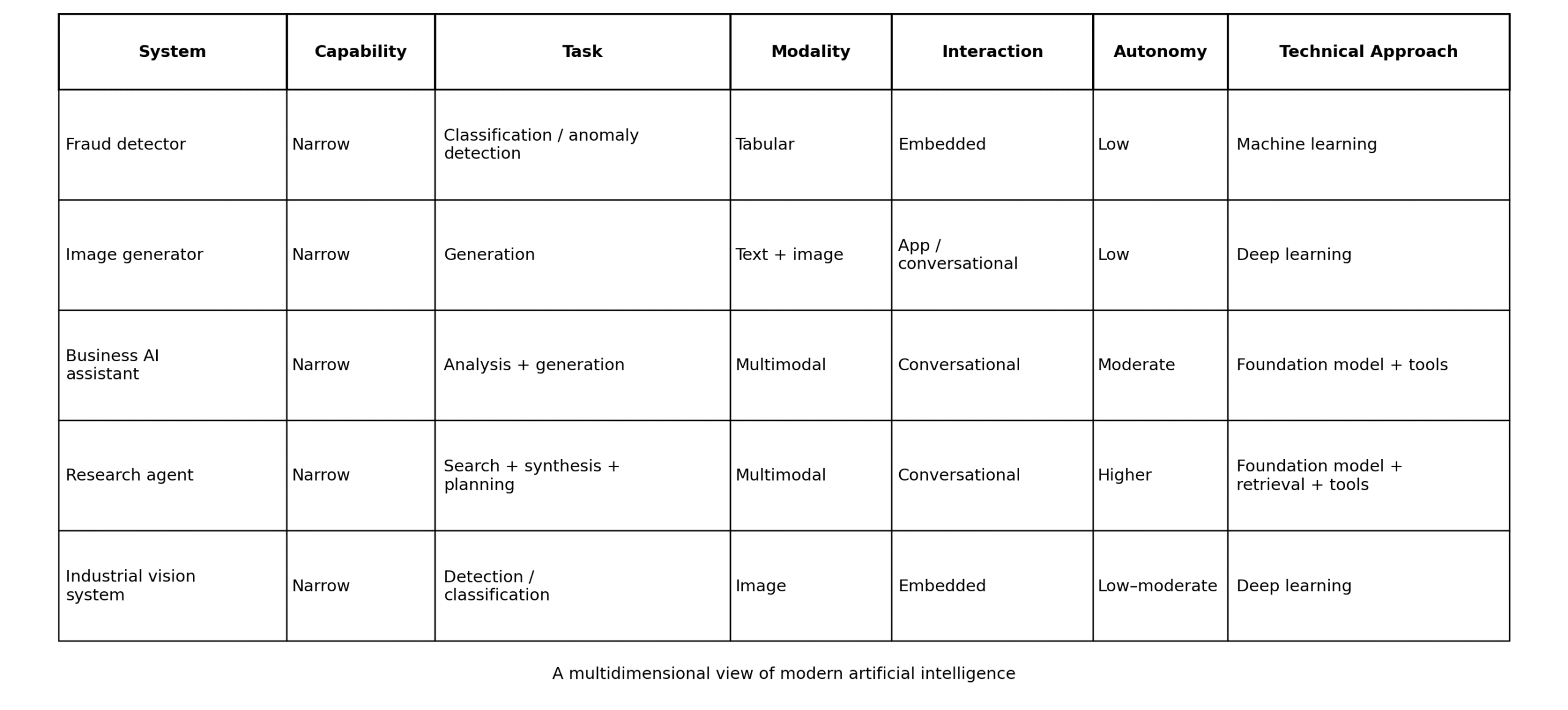
Notice that the same AI system can occupy several categories simultaneously.
That is not a contradiction.
The categories describe different properties.
A Better Way to Understand Any AI System
Instead of asking only:
“What type of AI is this?”
ask the following questions.
1. How broad are its capabilities?
Is it highly specialized, or does it demonstrate capabilities across many domains?
2. What tasks does it perform?
Does it classify, predict, generate, recommend, optimize, plan, or detect anomalies?
3. What information can it process?
Text? Images? Audio? Video? Tables? Several modalities?
4. How do users interact with it?
Through conversation, an application interface, APIs, or automated workflows?
5. How independently can it act?
Does it only return outputs, or can it plan, use tools, and perform actions?
6. How is it built?
Does it use rules, machine learning, deep learning, foundation models, retrieval, tools, or combinations of these?
7. Where does it operate?
Only in digital environments, or does it interact with the physical world?
These questions provide a much more useful description than assigning a single label.
Frequently Asked Questions
What are the main types of artificial intelligence?
There is no single universally accepted list of AI types.
AI can be classified according to capability, task, modality, interaction, autonomy, technical approach, and operating environment.
The popular Narrow AI, AGI, and ASI framework describes only one of those dimensions: capability.
Is Generative AI a type of artificial intelligence?
Yes, but Generative AI describes what a system is designed to produce rather than its overall intelligence level.
A Generative AI system can still be Narrow AI.
Is Agentic AI the same as AGI?
No.
Agentic AI refers to systems capable of pursuing goals using planning, tools, and actions.
AGI refers to the theoretical concept of broadly general intelligence.
A system can therefore exhibit agentic behavior while still being classified as Narrow AI.
Is an AI workflow the same as an AI agent?
Not necessarily.
A workflow usually follows software-defined paths.
An agent has greater control over deciding which steps and tools to use to accomplish a goal.
Is Multimodal AI more intelligent?
Not necessarily.
Multimodal means that a system can process or generate several types of information.
It does not by itself establish greater overall intelligence.
Are reasoning models AGI?
No.
Strong reasoning performance in selected tasks does not establish Artificial General Intelligence.
Reasoning is better understood as one aspect of AI capability.
Final Thoughts
Artificial intelligence is better understood as a multidimensional set of capabilities and technologies rather than a single ladder of types.
One system can be narrow in capability, generative in task, multimodal in input, conversational in interface, built on a foundation model, and agentic in operation—all at the same time.
That is why simple lists of “three types of AI” or “seven types of AI” can be misleading when they combine categories that describe different properties.
Instead of asking only:
“What type of AI is this?”
ask:
What can it do? What information can it process? How is it built? How do people interact with it? How independently can it act? And where does it operate?
Those questions provide a clearer and more accurate picture of modern artificial intelligence.